A steep climb can turn a quiet drive into a sustained demand for torque. Add a heavy load, hot weather, or repeated hill starts, and your EV may limit power to protect its components. The warning can feel sudden. The heat often builds gradually.
Why is my EV motor overheating on hills? The answer may involve more than the motor itself. Depending on the vehicle, the inverter, coolant circuit, radiator, or battery can also affect performance and trigger a warning. Low vehicle speed on a climb may reduce airflow, while a cooling pump or blocked radiator can make heat harder to remove. Still, these clues do not prove a specific part has failed.
This guide explains common causes and practical checks, including when to stop driving and seek professional diagnosis. Note the warning message, outside temperature, load, and whether power returns after the vehicle cools. Check the owner’s manual before continuing uphill; warning meanings vary by model. Don’t guess from one symptom. A reduced-power message may point to a protective limit, not a damaged motor. That distinction matters. It is easy to blame the steep road alone, but recurring overheating deserves attention, even if the car seems normal again afterward. A qualified EV technician can inspect cooling components and read vehicle fault codes. This article offers informed guidance, not a remote diagnosis.
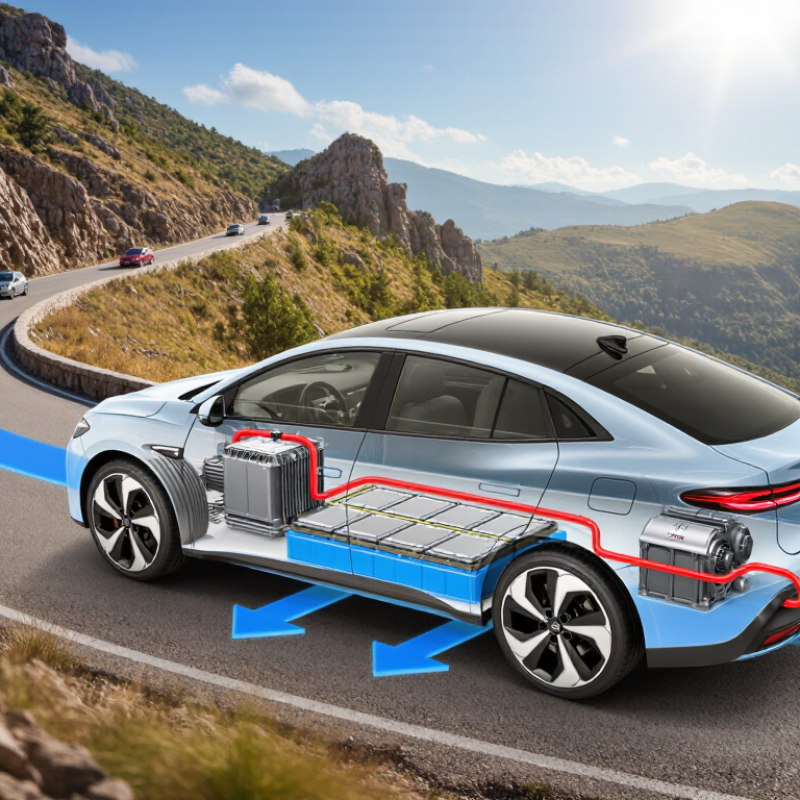
When an EV climbs a steep road, its motor must deliver more torque to lift the vehicle’s mass against gravity. That demand usually means higher electrical current. Inside the motor and its power electronics, some energy becomes heat through electrical resistance and magnetic losses. Resistance heating rises roughly with the square of current, so a sustained climb can warm components quickly. It’s not just the slope.
The U.S. Department of Energy’s Alternative Fuels Data Center estimates that EVs convert about 77% of grid energy into power at the wheels. The remaining energy is not all motor heat, but the figure shows that conversion losses exist even before a long climb adds load. At low climbing speeds, reduced airflow may also limit cooling, while repeated climbs can leave less time for temperatures to fall. A hot afternoon, heavy cargo, or a trailer can add strain. Small details matter. If a vehicle limits power on hills, that may be its thermal protection working—not necessarily a failed motor. Still, I would not dismiss repeated warnings as “normal”; the exact cause depends on sensor readings, cooling-system condition, and the vehicle’s design.
| Potential cause | Why climbing increases heat | Clues to look for | What to do |
|---|---|---|---|
| High motor load on a steep or long climb | The motor must supply more torque to raise the vehicle against gravity. Higher electrical current increases resistive heating in the motor windings. | Temperature warnings appear during sustained uphill driving, especially with a heavy load or rapid acceleration. | Ease off the accelerator, reduce speed where safe, and take a rest if the vehicle instructs you to. Follow the vehicle manual and warning messages. |
| Low speed under heavy torque | A slow, steep ascent can require substantial torque while providing less airflow over components than faster driving. Cooling performance depends on the vehicle’s design and operating conditions. | The warning occurs in slow traffic or on a steep grade and may lessen after driving gently or stopping safely. | Avoid repeated hard acceleration and stop-and-go climbing when possible. Do not stop in an unsafe location to cool the vehicle. |
| High ambient temperature or restricted cooling | Hot weather reduces the temperature difference available for heat rejection. Blocked airflow, a cooling-system fault, or low coolant where applicable can further limit cooling. | Overheating occurs more readily on hot days, or a warning returns during ordinary driving. Some EVs use liquid cooling; others use different designs. | Check for visible obstructions around air inlets and follow the manual. Have recurring warnings or suspected cooling faults inspected by a qualified technician. |
| Heavy vehicle load, trailer, or added drag | More mass requires more energy to climb. A trailer or roof load can also increase the power needed, depending on the route and speed. | The issue appears when carrying passengers, cargo, or a trailer, particularly on long grades. | Stay within the vehicle’s rated payload and towing limits, and use a steady, moderate driving style. |
| Repeated high-power acceleration | Rapid acceleration while already climbing can increase motor and power-electronics load, adding heat faster than the cooling system can remove it. | Temperature warnings follow bursts of acceleration or repeated demanding climbs with little recovery time. | Accelerate smoothly and allow time for temperatures to fall. Do not rely on a warning-free interval as proof that a recurring problem is fixed. |
| Fault or sensor issue | A faulty temperature sensor, wiring problem, motor, inverter, or cooling component can trigger warnings or cause genuine overheating. | Warnings recur on mild grades, appear soon after a cold start, or are accompanied by reduced power or diagnostic messages. | Arrange a diagnostic inspection. If the vehicle displays a stop or critical-temperature warning, pull over safely and follow its instructions. |
Illustrative climbing-power estimate: For an 1,800 kg vehicle on a 10% grade at 50 km/h, the power needed just to gain elevation is about 2.5 kW at the wheels (mass × gravity × grade × speed). This estimate excludes rolling resistance, aerodynamic drag, and drivetrain losses; actual demand is higher and varies with conditions. Temperature limits and cooling behavior differ by vehicle, so use the owner’s manual and dashboard guidance.
A steep climb demands more torque to lift the vehicle’s weight. Higher torque usually requires higher electrical current. Electrical resistance then produces more heat. The effect can become rapid.
No. The inverter, battery, reduction gear, cables, or cooling system may be responsible. A dashboard warning identifies risk, not always the exact component. Guessing can mislead.
Hot weather, heavy cargo, trailer weight, and underinflated tires increase thermal stress. Slow uphill traffic can reduce airflow through cooling openings. Repeated climbs leave little time for temperatures to fall.
Power may fade, acceleration may feel uneven, or a hot electrical smell may appear. Some vehicles automatically reduce output to protect components. That is a warning. Do not push harder uphill.
Move to a safe stopping place when possible. Turn the vehicle off and allow the system to cool. Arrange professional assistance if warnings return. Smoke requires urgent attention.
Yes. Blocked inlets, debris, damaged hoses, low coolant, or a weak pump can limit cooling. Check visible airflow paths when the vehicle is safely parked. Never open a pressurized coolant system while it is hot.
A technician can scan stored fault codes and compare motor, inverter, and battery temperatures. They can test the cooling pump, fan, sensors, hoses, and electrical connections. Intermittent faults may need a second inspection.
Remove unnecessary weight and check tire pressure before departure. Inspect coolant levels and cooling openings if the vehicle uses liquid cooling. Record the gradient, outside temperature, cargo, and warning message. Some assumptions fail; measured data is better.
Why is my EV motor overheating on hills? Steep climbs demand sustained torque and higher power, which can raise motor temperature, especially when the vehicle is heavily loaded, airflow is limited, or cooling components are not working properly. Other possible causes include repeated hard acceleration, prolonged low-speed climbing, restricted coolant flow, a faulty temperature sensor, or excessive heat from nearby electrical components. Because the battery and inverter can also heat up under load, temperature readings and warning messages should be checked to identify the source rather than assuming the motor is responsible.
Warning signs may include a motor-temperature alert, reduced power, unusual noises, or performance that returns to normal after cooling. Diagnostic checks can include reviewing temperature data, inspecting the cooling system, and having a qualified technician examine sensors and electrical connections. To reduce heat, maintain a steady pace, avoid unnecessary acceleration, reduce excess weight, and pause safely when warnings appear. Follow the vehicle’s guidance and arrange service if overheating recurs.

 Evergreen Vehicle